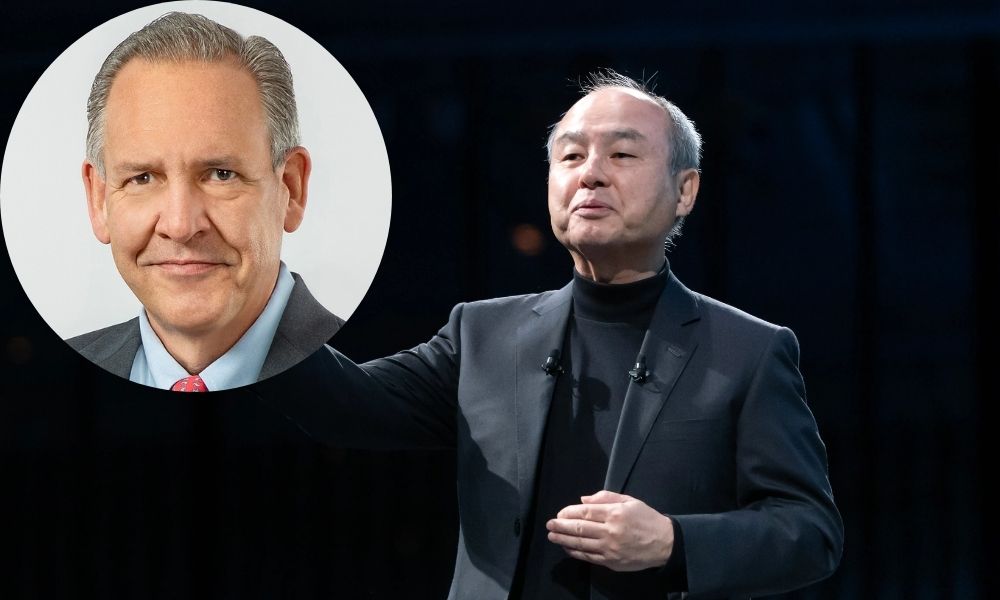
Masayoshi Son and Greg Hayes show up in the same searches, but they have never shared a business. Son is the SoftBank founder who now holds about 13% of OpenAI, while Hayes is the former RTX CEO who reshaped an aerospace giant and left on a planned two-year exit. SoftBank’s cumulative OpenAI investment stands at $64.6 billion for a 13% stake. No public source shows a partnership between them.
Below are verified profiles, a side-by-side table, SoftBank’s latest numbers and Hayes’s current roles, all checked as of October 27, 2026.
Quick Facts: Masayoshi Son vs Greg Hayes
Before the stories, here is the whole picture in one place.
| Detail | Masayoshi Son | Greg Hayes |
| Born | August 11, 1957, in Tosu, Saga, Japan | Around 1960 or 1961, American businessman |
| Education | University of California, Berkeley | Economics degree from Purdue, certified public accountant |
| Career start | Founded Nihon SoftBank in Fukuoka in September 1981 | Joined United Technologies in 1999 through the Sundstrand merger |
| Top role | Chairman and CEO of SoftBank Group | CEO of United Technologies from 2014, then CEO of RTX from 2020 |
| Signature deal | A $20 million Alibaba bet in 2000 that returned $72 billion | The April 2020 merger that formed RTX |
| Status in 2026 | Still leads SoftBank, per Reuters coverage in October 2026 | Left the RTX board on April 30, 2025 |
| Latest headline | $64.6 billion invested in OpenAI | Joined the BD board on March 26, 2025 |
| Public link between them | None found | None found |
The last row raises the obvious question, so let’s answer it next.
Are Masayoshi Son and Greg Hayes Connected?
No public evidence of a partnership
I reviewed company biographies, SEC filings, press releases and major news reports for both men. None describes a joint deal, shared board seat or business relationship. SoftBank invests in technology and AI infrastructure. RTX builds aircraft engines, aerospace systems and defense products.
Why the two names are searched together
The pairing shows up mostly in comparison articles and search suggestions, not in any announcement from SoftBank or RTX. Both men have also appeared in stories tied to US policy. That is context for readers, not a link between them. With that cleared up, let’s take each man in turn, starting with the investor.
Must Read: Brad Pitt and Greg Hayes: Is the Link Real? The Facts (2026)
Who Is Masayoshi Son?
Early Life and the Founding of SoftBank (1981)
SoftBank began in September 1981 when a 24-year-old Son set up the company in Fukuoka. It started in software distribution and kept moving into bigger bets. It set up Yahoo Japan with the American Yahoo and later acquired Vodafone’s Japanese business.
The overseas moves came next, and they were not all wins. SoftBank bought Sprint in 2013 but could not win the US market, a rare failure for the company. In 2016, it bought British chip designer Arm Holdings for more than $32 billion, completed on September 5, 2016. Arm then listed on Nasdaq in September 2023.
His Biggest Bet: The Alibaba Investment
If one trade explains Son’s reputation, this is it. SoftBank put $20 million into Alibaba in 2000, which produced a $72 billion return before most of the stake was sold in 2023. It is the reason investors still treat him as a rare visionary. It is also the reason critics say one great bet can hide many weaker ones.
Setbacks: WeWork, the Nvidia Sale and Vision Fund Losses
The misses are just as instructive. The $100 billion Vision Fund launched in 2017 put billions into WeWork, which filed for bankruptcy in 2023. In the 2022 to 2023 financial year, the two Vision Funds lost 4.3 trillion yen, about $32 billion at the time. SoftBank also sold its Nvidia shares in 2019 and missed the AI boom gains.
Son’s Investment Philosophy
Put the wins and losses together, and a pattern appears. Son’s approach has always centered on long-term, transformative technologies. He concentrates capital on one wave at a time, which explains both Alibaba and Sprint. That habit is now playing out at a far larger scale.
Masayoshi Son in 2025 and 2026: OpenAI, Stargate and the AI Bet
The Stargate Project
The newest chapter began at the White House. In January 2025, Son appeared with President Trump, OpenAI’s Sam Altman and Oracle’s Larry Ellison to announce Stargate, an AI infrastructure plan starting at $100 billion. SoftBank took financial responsibility, Son became chairman, and OpenAI took operational control. The first data center, in Abilene, Texas, began operating in September 2025.
SoftBank’s OpenAI Investment
Stargate is only half of the story. The bigger number is the stake in OpenAI itself. SoftBank paid the last $10 billion tranche of its $30 billion follow-on investment on October 1, 2026, lifting its total to $64.6 billion for about 13%. That money was part of OpenAI’s $122 billion round at an $852 billion valuation. To fund it, SoftBank raised $11.1 billion in the largest high-yield corporate bond sale globally.
Selling Nvidia and Buying Arm, Ampere, Robotics and Infrastructure
Funding that bet meant selling other assets and buying around it. SoftBank sold its whole Nvidia stake for $5.8 billion in 2025 to fund OpenAI commitments. It bought chipmaker Ampere Computing for $6.5 billion in March 2025. It also agreed to buy digital infrastructure investor DigitalBridge in a deal valued at $4 billion.
Profits, Debt and Risk: What Analysts Are Watching
SoftBank’s recent profits look huge, but most are valuation gains rather than cash. The year to March 2026 brought a $46 billion Vision Fund gain driven mainly by OpenAI. Here is what to keep in mind when you read the headlines:
- The OpenAI stake is valued by estimate, not market price: $89.6 billion against a $44.6 billion cost as of June 30, 2026.
- OpenAI’s weight in the portfolio has raised debt concerns, though the CFO cites a 3.5 trillion yen cash position.
- Reuters notes SoftBank’s finances could become vulnerable if sentiment toward OpenAI weakens significantly.
- SoftBank shares fell 6% on October 2, 2026, after the final payment.
Is Son Planning to Step Down?
Investors keep asking this, and Son’s answer is clear. At the 2025 shareholders’ meeting, he said he has potential successors within the group, praised telecom head Junichi Miyakawa, and said he has no immediate plans to step down. Now let’s turn to the executive who left on a very different schedule.
Must Read This: Tim Dove and Shari Redstone: Are They Really Connected? 2026
Who Is Greg Hayes?
From Sundstrand to United Technologies (1999 to 2014)
Hayes grew up inside the corporate machine rather than building it from scratch. He joined United Technologies in 1999 through the Sundstrand merger and served as chief financial officer from 2008 to 2014. He became CEO in November 2014 and chairman in 2016. That finance background shaped everything he did next.
Transforming UTC: Sikorsky, Rockwell Collins, Otis and Carrier
His first big project was making the company smaller in scope. Hayes turned UTC from an industrial conglomerate into a focused aerospace company, selling Sikorsky in 2015 and buying Rockwell Collins in 2018. The spinoffs of Otis and Carrier followed in 2020.
Creating RTX Through the Raytheon Merger (2020)
That cleanup set up his defining deal. He led the merger of Pratt & Whitney and Collins Aerospace with Raytheon to form RTX in April 2020, becoming its CEO. By the time he handed over, RTX had over 185,000 employees and more than $80 billion in annual sales.
Notable Moments: Aerojet Criticism and China Sanctions
Two episodes show how exposed a defense CEO can be. In December 2022, Hayes called Aerojet Rocketdyne the weak link in RTX’s supply chain, citing delayed engine deliveries and quality problems. In September 2022, China sanctioned Hayes and Boeing Defense CEO Ted Colbert over their involvement in a $1.1 billion US arms sale to Taiwan. Officials did not say what the sanctions would involve.
What Is Greg Hayes Doing After RTX?
Handover to Chris Calio and Exit Timeline (2024 to 2026)
Hayes did not leave all at once, and that is the lesson. RTX announced in December 2023 that Chris Calio would succeed him. Calio became CEO on May 2, 2024, and Hayes became executive chairman. He then left the board effective April 30, 2025, and served as special advisor through January 2, 2026. At the time of writing, I found no public announcement of a new executive job for him.
Current Boards: BD, Phillips 66 and NAF
So where does he spend his time now? BD lists him as a director, notes his Phillips 66 seat, and says he chairs the National Academy Foundation. His BD role took effect March 26, 2025, and BD’s CEO tied it to his record on portfolio optimization. Phillips 66 filings show he has served on its board since 2022.
Leadership Compared: Investor vs Industrial Operator
Put the two careers side by side, and the contrast is sharp.
Son builds by betting. He picks a technology wave, commits large sums and lets the market decide. The results are lumpy: Alibaba turned $20 million into $72 billion, while Sprint and WeWork destroyed value.
Hayes builds by editing. He sold or spun off businesses that did not fit, bought Rockwell Collins to strengthen aerospace, and merged with Raytheon for scale. His results show up in company structure rather than a single bet.
Succession shows the gap too. Hayes named his successor months ahead and left in stages. Son says he has successors in mind but no plan to leave, which fits a founder who still steers his own company.
Neither style is better in general. A company with decades-long engineering cycles needs steady portfolio management. A technology investor needs conviction when the future is uncertain.
Also Read This: David Lawler and Bruce Broussard: Careers, Roles, Connection
Timeline: Son and Hayes (1957 to 2026)
Here is the sequence of events in one view.
| Year | Event | Who |
| 1957 | Born in Tosu, Japan | Son |
| 1981 | Founds SoftBank in Fukuoka | Son |
| 1999 | Joins United Technologies via Sundstrand | Hayes |
| 2000 | SoftBank invests $20 million in Alibaba | Son |
| 2006 | SoftBank acquires Vodafone’s Japanese business | Son |
| 2013 | SoftBank buys Sprint | Son |
| 2014 | Becomes CEO of United Technologies | Hayes |
| 2016 | SoftBank completes the Arm acquisition; Hayes becomes UTC chairman | Both |
| 2017 | SoftBank launches the $100 billion Vision Fund | Son |
| 2020 | UTC’s aerospace units merge with Raytheon to form RTX | Hayes |
| 2022 | China sanctions Hayes over Taiwan arms sales; he joins the Phillips 66 board | Hayes |
| 2023 | Arm lists on Nasdaq; RTX names Calio as Hayes’s successor | Both |
| 2024 | Calio becomes CEO on May 2; Hayes turns executive chairman | Hayes |
| 2025 | Stargate announced in January; Hayes joins BD’s board on March 26; he leaves RTX’s board on April 30 | Both |
| 2026 | Hayes’s advisor role ends January 2; SoftBank completes its $30 billion OpenAI follow on on October 1 | Both |
What Business Readers Can Learn From Their Careers
The timeline is interesting, but the real value is in what it teaches.
Concentration cuts both ways
Alibaba made SoftBank famous, Sprint hurt it, and OpenAI now sits at about 13% ownership funded partly by borrowing. Before copying a bold strategy, ask what happens if the bet fails.
Focus can create value
UTC became more valuable as an aerospace company after Hayes removed businesses that did not fit. Less variety can mean sharper management attention.
Paper gains are not cash
SoftBank’s headline profits come from valuation changes. Always separate realized profit from marked-up value.
Plan the exit
Hayes’s staged departure gave RTX continuity. Any leader can borrow that idea by naming a successor early.
Conclusion
Masayoshi Son and Greg Hayes have no known business link, yet their careers show two ways to run a large company. Son concentrates capital on technology waves and now holds about 13% of OpenAI. Hayes reshaped United Technologies into a focused aerospace group, led RTX through its first years and exited in planned stages. If you follow AI investing, keep watching SoftBank’s OpenAI exposure and its debt. If you follow aerospace and governance, watch Hayes’s board roles at BD and Phillips 66.
FAQ’s
Are Masayoshi Son and Greg Hayes business partners?
No. No public source shows a partnership, joint investment or shared board seat. They lead or led companies in different industries.
Who is Masayoshi Son?
He is the founder, chairman and CEO of SoftBank Group, known for Alibaba, Arm, the Vision Fund and OpenAI.
Is Masayoshi Son still CEO of SoftBank?
Yes. Reuters coverage in October 2026 still describes SoftBank as led by founder Masayoshi Son.
Who is Greg Hayes?
Gregory J. Hayes is the former CEO of United Technologies and the first CEO of RTX. He served as executive chairman until April 2025.
Who replaced Greg Hayes as RTX CEO?
Chris Calio. He was elected president and CEO on May 2, 2024.
Where does Greg Hayes work now?
He is no longer at RTX. He is a director at BD and Phillips 66 and chairs the National Academy Foundation.
How much has SoftBank invested in OpenAI?
A total of $64.6 billion for a 13% stake, as of October 2026. The figure can change if OpenAI raises new funding.
What is Stargate?
An AI infrastructure joint venture created by OpenAI, SoftBank, Oracle and MGX, launched with $100 billion and a plan to reach $500 billion.
Are SoftBank and RTX in the same industry?
No. SoftBank is a technology investment holding company, while RTX is an aerospace and defense manufacturer.
I’m Elyon Marwood, the voice behind BlessWithUs. Writing has always been more than just words for me; it’s a way to share faith, spread hope, and bring light into someone’s day. Through heartfelt blessings, meaningful prayers, and uplifting messages, I create moments that help you slow down, feel at peace, and reconnect with what truly matters. Every piece I write carries a purpose to comfort your heart, strengthen your faith, and remind you that even in the quietest moments, you are deeply guided, loved, and blessed.